
Steel Review: Cloud Browser Infrastructure for AI Agents
An evidence-based Steel review covering ideal users, use cases, strengths, limitations, pricing, setup, and decision criteria for AI agent browser infrastructure.

Steel Review: Cloud Browser Infrastructure for AI Agents
Steel is an open-source browser API and cloud infrastructure platform that lets developers control fleets of real browsers for AI agents and web automation. This review examines its ideal users, use cases, strengths, limitations, pricing signals, setup, and decision criteria, drawing on the product's stated capabilities and independent comparisons.
What Steel Is (and Isn't)
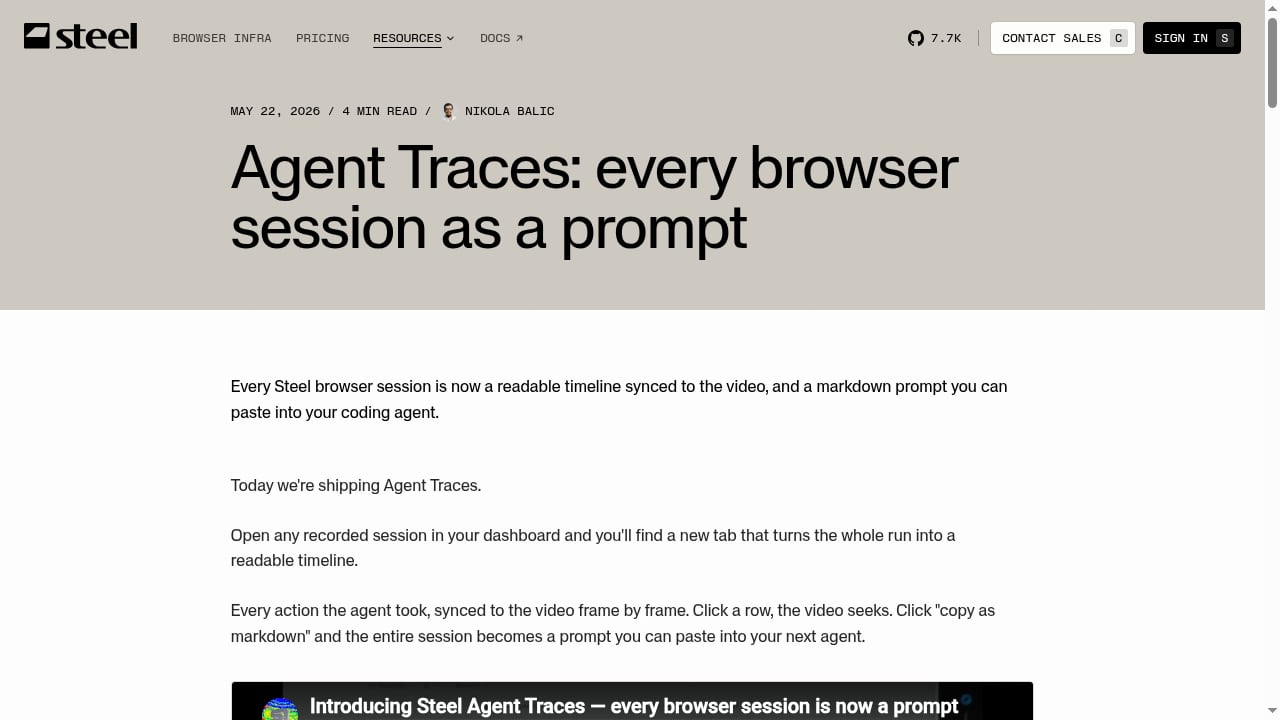
First viewport screenshot of Steel | Agent Traces: every browser session as a prompt.
Steel provides a managed runtime where agents can spin up thousands of concurrent browser sessions, each starting in under a second, to search, scrape, navigate, and interact with the live web. It positions itself as "the computer for AI agents," contrasting with human-oriented browsers like Chrome and DIY frameworks like Puppeteer or Playwright that require teams to manage browser instances, proxies, and CAPTCHA solving themselves.
It is not a general-purpose web browser for people, nor a turnkey data-delivery service. It is infrastructure: an API layer that abstracts away browser fleet management, session persistence, and anti-bot concerns.
Ideal Users
First viewport screenshot of Steel | Blog.
Steel is designed for engineering teams building AI agents, scrapers, QA testers, and research tools that need reliable, scalable web access without managing browser infrastructure. Specifically:
- AI agent developers who need agents to browse, click, and extract information from live sites at scale.
- Web scraping teams that want to avoid building and maintaining their own browser pools, proxy rotation, and stealth layers.
- QA and testing engineers running parallel browser sessions for automated checks.
- Research tool builders who need to capture web evidence and turn it into cited reports (Steel ships Atlas, an open-source deep research harness for this).
Teams that only need occasional screenshots or simple page fetches are likely over-served by Steel's concurrency-oriented model.
Key Use Cases
- Agentic web navigation: Agents that search, fill forms, and follow multi-step workflows across sites.
- Large-scale scraping: Concurrent sessions with dedicated IPs and stealth support to reduce blocking.
- Session-persistent automation: Maintaining cookies, logins, and profiles across steps—see our guide to session persistence in browser automation for how stateful CDP sessions work.
- Debugging agent behavior: Session recording, agent logs, and traces help teams diagnose why an agent failed.
- Deep research: Atlas turns web evidence into cited reports, useful for research-oriented products.
Strengths
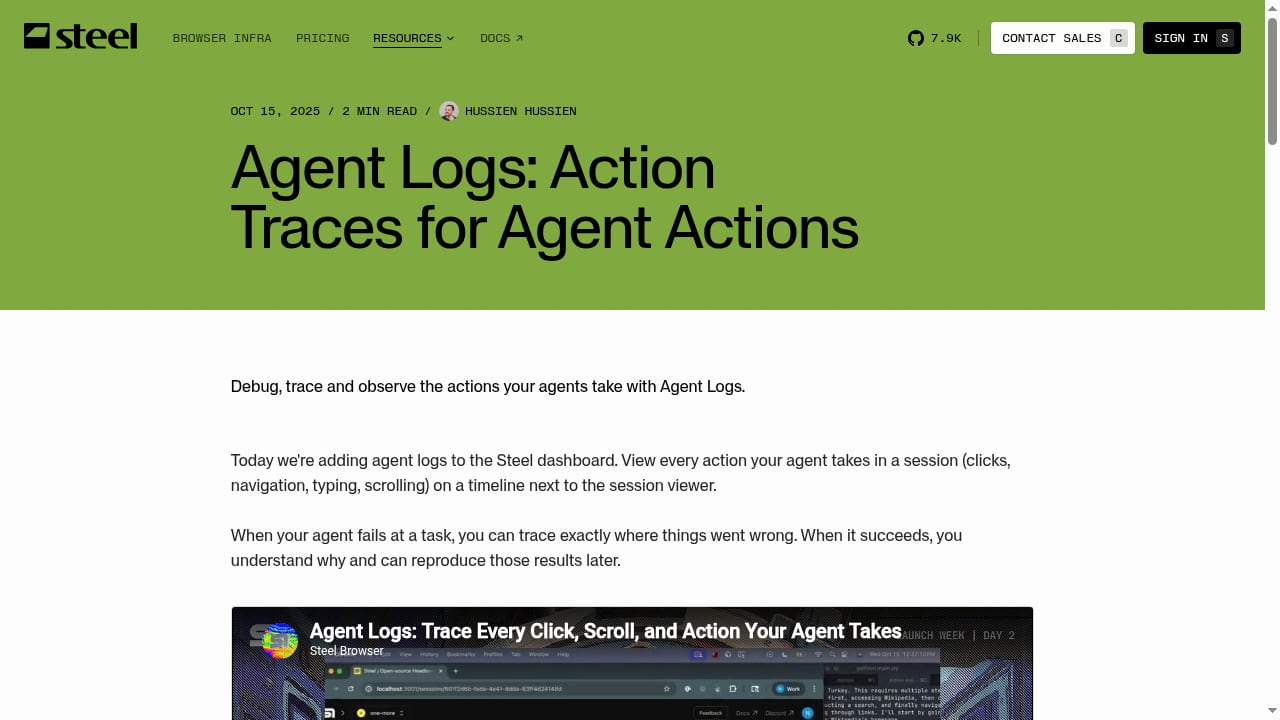
First viewport screenshot of Steel | Agent Logs: Action Traces for Agent Actions.
Based on the product context, Steel's notable strengths include:
- Sub-second session startup, which matters when agents need many short-lived sessions.
- High concurrency: Scale plan supports 100 concurrent sessions; Enterprise supports 1,000+ with reserved browser pools.
- Built-in anti-bot and stealth browser support, plus dedicated IPs on paid tiers.
- Session persistence and recording, reducing the engineering burden of state management.
- Observability: Agent logs and traces for debugging.
- SDKs for Rust and Go, alongside standard browser automation protocols.
- Open-source core, which lowers lock-in risk and allows self-hosting evaluation.
- Proven usage: Over 30,000 engineers, millions of browser sessions weekly, and more than 1.5 million browser hours served.
Limitations and Trade-offs
- Pricing jumps: The free Launch tier includes $30 in credits, but the Scale plan starts at $250 per month—a meaningful step for small teams. Enterprise pricing is custom.
- Concurrency ceilings: 100 concurrent sessions on Scale may be tight for large scraping fleets; higher concurrency requires Enterprise.
- Stealth and reserved pools are Enterprise-only, so teams needing advanced anti-bot features early may face a sales conversation.
- Not a data-delivery product: Steel provides browser access, not structured datasets; teams still build extraction and delivery pipelines.
- Ecosystem maturity: SDK coverage (Rust, Go) is narrower than some competitors' language support, though standard automation frameworks can still connect.
Pricing Signals
Steel's published tiers suggest a usage-based, concurrency-tiered model:
- Launch (free): $30 in credits to evaluate the platform.
- Scale: $250 per month with 100 concurrent sessions and dedicated IPs.
- Enterprise: Custom pricing with 1,000+ concurrent sessions, stealth browser, reserved browser pools, and uptime SLAs.
For a broader market comparison, see our roundup of top cloud browser infrastructure for AI agents, which covers pricing, concurrency, stealth, and self-hosting across vendors.
Setup and Developer Experience
First viewport screenshot of Steel | How Websites Decide You're Human.
Setup follows a typical API-first pattern: obtain credentials, connect via SDK or a browser automation protocol, and launch sessions programmatically. Because Steel manages the browser fleet, teams avoid provisioning servers, configuring proxies, or patching anti-bot measures themselves. The open-source core allows local evaluation before committing to a paid tier. Session recording and traces are available for debugging, which shortens the feedback loop when agents misbehave.
For teams comparing browser automation SDK options, our browser automation SDK comparison covers Stagehand, Browser Use, Skyvern, Playwright MCP, and more.
Decision Criteria
Choose Steel if:
- You are building AI agents or scrapers that need many concurrent, real browser sessions.
- You want to offload browser fleet management, proxies, and basic anti-bot handling.
- You value open-source access and sub-second session startup.
- Your concurrency needs fit Scale (100) or you can commit to Enterprise.
Consider alternatives if:
- You need turnkey structured data delivery rather than browser access—see our AdsCrawl vs Steel vs Zyte comparison for how managed data delivery differs.
- You need advanced stealth from day one on a low budget.
- You require broad SDK language coverage beyond Rust and Go.
Related reading
- How to Use AdsCrawl with Price API for Data-Driven E-Commerce - Combine AdsCrawl cloud browser rendering with Price API to extract and enrich e-commerce pricing data. Setup steps, code workflow, and practical examples.
FAQ
Is Steel open source? Yes, Steel is described as an open-source browser API and cloud infrastructure platform, with Atlas also open source.
How fast do Steel sessions start? The product states sub-second session startup.
What concurrency does Steel support? The Scale plan includes 100 concurrent sessions; Enterprise plans support 1,000+ concurrent sessions with reserved browser pools.
Does Steel handle CAPTCHAs and anti-bot measures? It offers built-in anti-bot and stealth browser support, with stealth browser and dedicated IPs emphasized on higher tiers.
Who should not use Steel? Teams needing only occasional screenshots, simple page fetches, or turnkey structured datasets may find Steel's concurrency-oriented infrastructure excessive.
Conclusion
Steel is a credible, evidence-backed option for engineering teams that need scalable, real-browser infrastructure for AI agents and automation. Its strengths—sub-second startup, high concurrency, session persistence, observability, and open-source access—map directly to the pain points of agent and scraping teams. Its limitations—pricing steps, concurrency ceilings on Scale, and Enterprise-gated stealth—are worth weighing against your expected session volume and anti-bot needs. For teams building agentic web access, Steel deserves a place on the shortlist.
Sources: Rotten Tomatoes – Steel, IMDb – Steel (2015), IndieWire – Review: Sven J. Matten's 'Steel'