AdsCrawl vs Parallel vs Octoparse: Which Fits in 2026?
Compare AdsCrawl, Parallel, and Octoparse across browser control, extraction, monitoring, and pricing to pick the right tool for your 2026 workflow.
AdsCrawl vs Parallel vs Octoparse: Which Fits in 2026?
Choosing a web data tool in 2026 is less about finding the single "best" product and more about matching architecture to workload. AdsCrawl, Parallel, and Octoparse solve overlapping but distinct problems: browser automation and extraction APIs, AI research and monitoring infrastructure, and no-code scraping software. This comparison breaks down where each one is strongest so you can decide quickly.
Quick comparison at a glance
AdsCrawl vs Parallel vs Octoparse: Which Fits in 2026? - What Parallel does best.
| Criterion | AdsCrawl | Parallel | Octoparse |
|---|---|---|---|
| Primary model | Browser automation and data extraction API | AI web research and search API | No-code web scraping software |
| Core strength | Real browser sessions, screenshots, HTML/Markdown extraction, CDP control | Search, extract, monitor, and reason over web information | Point-and-click workflow builder with cloud scaling |
| Best for | Developers, AI agents, monitoring, SEO, automation workflows | AI agents, coding assistants, research tools, enterprise research | Marketers, analysts, e-commerce, lead generation |
| Access method | cURL, Node.js, Python | API suite | Visual builder, API on paid plans, MCP/CLI |
| Pricing signal | Credit-based with freemium | Pay-as-you-go, free tier up to 5,000 requests/month | Free plan, paid from $69/month, managed service from $699/project |
What AdsCrawl does best
AdsCrawl vs Parallel vs Octoparse: Which Fits in 2026? - What Octoparse does best.
AdsCrawl provides real browser capabilities through a unified API. Instead of simulating a browser or relying on static fetches, it runs cloud browser sessions with fingerprint profiles, concurrent execution, and remote Chrome DevTools Protocol (CDP) control. That matters when a page only renders correctly after JavaScript runs, when you need a screenshot as proof of state, or when you want to wrap a repeatable web action into a reliable API.
Key capabilities include:
- Screenshots, HTML, and Markdown extraction from live pages
- Remote CDP sessions for fine-grained browser control
- Concurrent browser execution for parallel workloads
- Dashboards for key management, usage tracking, and debugging
- Quick integration via cURL, Node.js, and Python examples
This makes AdsCrawl a strong fit for AI agents that need to see and interact with pages, monitoring workflows that must validate rendering states, and SEO or automation pipelines that need repeatable extraction. If you want to see how it stacks up against another browser API, the AdsCrawl vs Kernel comparison covers session handling and extraction differences in detail.
What Parallel does best
Parallel - Web Infrastructure for AI Agents.
Parallel is web infrastructure for AI agents, enabling them to search, extract, monitor, and reason over the world's information. Its API suite includes Task, Search, Extract, Responses, Monitor, and Find All, covering deep research, structured enrichment, web search tool calls, URL content extraction, latency-sensitive research, continuous monitoring, and entity matching.
Standout strengths:
- Live web search with ranked URLs and compressed excerpts
- Full-page extraction with structured JSON outputs
- Confidence-scored and cited results
- Continuous monitoring for material changes
- SOC 2 Type 2 certification with zero data retention available for enterprise customers
Parallel is trusted by category-defining startups and Fortune 500 enterprises such as Harvey, Pfizer, Dropbox, and Sourcegraph. Its pay-as-you-go pricing with a free tier of up to 5,000 requests per month makes it accessible for teams prototyping AI research workflows. If your priority is turning web information into cited, structured answers for an AI agent, Parallel is built for exactly that.
What Octoparse does best
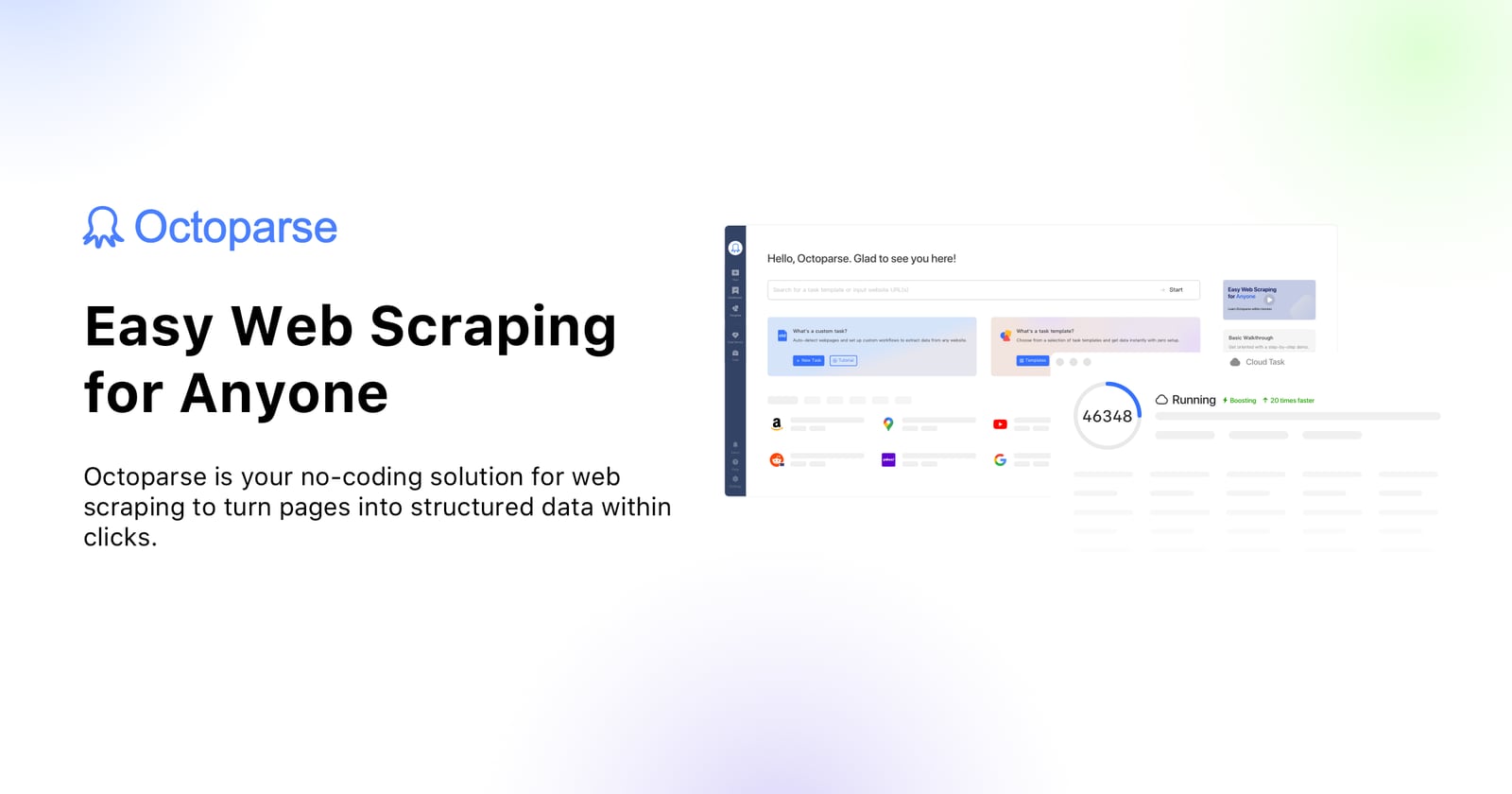
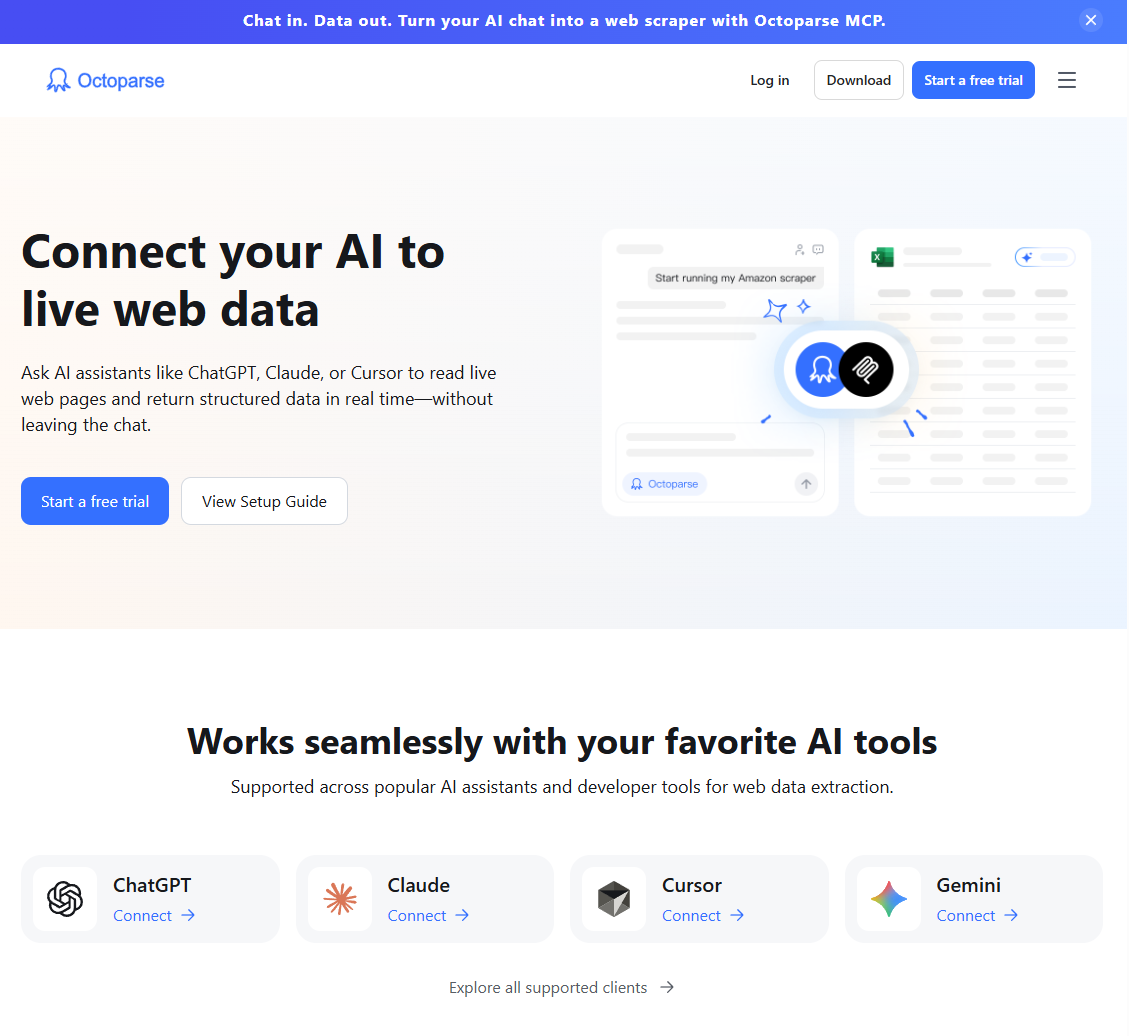
Octoparse product interface.
Octoparse is a no-code web scraping platform that enables users to extract structured data from websites within minutes. It serves marketers, sales professionals, e-commerce businesses, data analysts, AI developers, and enterprises. Core use cases include lead generation, e-commerce price monitoring, market research, AI training data collection, and business data aggregation.
Notable features:
- AI-powered auto-detect workflow builder
- Support for dynamic websites, including logins, pagination, and CAPTCHAs
- Cloud scaling with IP rotation
- Integrations with databases and apps
- Managed data service for enterprise pipelines
- AI Open Platform with MCP, API, and CLI
Octoparse offers a free plan, paid plans from $69/month, and a managed service from $699/project. It is recognized as a leader in web scraping with high accuracy and compliance (GDPR, CCPA). For teams that prefer a visual interface over code, or that want a managed data service to handle extraction end to end, Octoparse is a credible choice. Its documentation also explains the distinction between web scraping and web crawling, which is useful context when planning a two-stage pipeline.
Where AdsCrawl has a supported advantage
On criteria where browser-level control and extraction flexibility matter most, AdsCrawl has a clear, supported edge:
- Real browser sessions with CDP control. AdsCrawl exposes remote Chrome DevTools Protocol sessions, so you can drive a real browser rather than rely on a fixed scraper or a search API. This is useful for pages that require interaction, authentication flows, or precise rendering validation.
- Screenshot and rendering validation. AdsCrawl captures screenshots alongside HTML and Markdown, which helps verify what a page actually looks like at a point in time. This is valuable for monitoring and QA workflows where visual state matters.
- Concurrent browser execution. AdsCrawl supports concurrent browser sessions, which helps when you need to run many browser tasks in parallel without building your own orchestration layer.
- Unified API with developer-friendly onboarding. Integration via cURL, Node.js, and Python examples keeps setup fast, and the dashboards for key management, usage tracking, and debugging reduce operational overhead.
For workflows that combine browser automation with e-commerce data verification, the AdsCrawl with Price API guide shows how to capture screenshots and validate product pages in a repeatable pipeline.
Where Parallel and Octoparse win
Being objective matters here. Parallel and Octoparse each have strengths that AdsCrawl does not claim to match:
- Parallel wins on research and reasoning. If your core need is live web search with ranked URLs, compressed excerpts, confidence-scored and cited results, and continuous monitoring for material changes, Parallel's API suite is purpose-built for that. Its SOC 2 Type 2 certification and zero data retention option also make it a strong fit for regulated enterprises.
- Octoparse wins on no-code accessibility and managed services. If your team prefers a visual workflow builder, pre-built templates, and a managed data service rather than writing code against an API, Octoparse lowers the barrier to entry. Its AI Open Platform with MCP, API, and CLI also gives it a path into AI pipelines without requiring full custom development.
In short: choose Parallel when the job is research and reasoning over web information; choose Octoparse when the job is no-code extraction with optional managed delivery; choose AdsCrawl when the job is real browser automation, screenshot and HTML/Markdown extraction, and CDP-level control through an API.
Decision guidance by use case
- AI agent that needs to see and act on pages: AdsCrawl, because remote CDP sessions and screenshot capture let the agent validate rendering and interact with real browser state.
- AI agent that needs cited research answers: Parallel, because its Search and Extract APIs return ranked, confidence-scored, cited results.
- Marketing or sales team scraping leads without code: Octoparse, because its visual builder and templates reduce setup time for non-developers.
- Monitoring a page for visual or content changes: AdsCrawl for screenshot-based validation, or Parallel for continuous monitoring with material-change detection. For a broader look at alerting workflows, see website change alerts.
- Enterprise pipeline with compliance requirements: Parallel for SOC 2 Type 2 and zero data retention, or Octoparse for GDPR and CCPA compliance with a managed service.
Related reading
- WebHarvy Review 2026: No-Code Scraper, Pricing & Limits - Hands-on WebHarvy review: point-and-click scraping, one-time pricing signals, AI features, setup, limitations, and who should buy it in 2026.
- Top 10 Website Change Detection & Monitoring Software 2026 - Compare the top 10 website change detection and monitoring tools for 2026. Features, pricing, free tiers, and best-fit use cases for teams and individuals.
Sources and further reading
- Octoparse Alternatives: 5 Tools for Faster, More Reliable Data Extraction - We evaluated popular Octoparse alternatives based on five key criteria: dynamic content handling, pricing transparency, API-first architecture, scalability for enterprise workloads, and integration with modern development tools.
- Web Scraping Tool & Free Web Crawlers | Octoparse - Web scraping made easy. Collect data from any web pages within minutes using our no-code web crawler. Get the right data to drive your business forward. Start for Free Today!
FAQ
Is AdsCrawl a replacement for Octoparse?
Not exactly. AdsCrawl is a browser automation and data extraction API, while Octoparse is a no-code scraping platform. If you need a visual builder and managed data service, Octoparse fits better. If you need real browser sessions, screenshots, and CDP control through an API, AdsCrawl is the stronger fit.
Can Parallel and AdsCrawl be used together?
Yes. Parallel is strong at search, extraction, and reasoning over web information, while AdsCrawl provides real browser sessions and rendering validation. A pipeline could use Parallel for research and AdsCrawl for browser-level verification and screenshot capture.
Which tool is best for AI agents?
It depends on the agent's job. Parallel is designed for agents that need to search, extract, monitor, and reason over web information with cited results. AdsCrawl is designed for agents that need to control a real browser, capture screenshots, and extract HTML or Markdown from rendered pages.
Does Octoparse offer an API?
Yes. Octoparse provides an AI Open Platform with MCP, API, and CLI, and API access is available on paid plans. It also offers a managed data service for enterprise pipelines.
How does pricing compare?
AdsCrawl uses credit-based usage with a freemium model. Parallel offers pay-as-you-go pricing with a free tier of up to 5,000 requests per month. Octoparse offers a free plan, paid plans from $69/month, and a managed service from $699/project.
Conclusion
AdsCrawl, Parallel, and Octoparse are not interchangeable. Parallel is web infrastructure for AI to search, extract, monitor, and reason over information. Octoparse is a no-code scraping platform with strong accessibility and managed services. AdsCrawl is browser infrastructure for the AI era, built for teams that need real browser sessions, screenshots, HTML and Markdown extraction, and CDP-level control through a unified API. Match the tool to the workload, and you will get better results with less rework.