
AdsCrawl vs Axiom.ai: Anti-Detect Browser Automation Showdown
Compare AdsCrawl vs axiom.ai for browser automation, data extraction, and anti-detection. See why IT teams prefer AdsCrawl's API-first cloud browsers.
AdsCrawl vs Axiom.ai: Which Browser Automation Platform Fits Your AI-Driven Workflows?
Choosing between browser automation tools often means deciding whether you need a no-code browser extension or a developer-first cloud API. In this head-to-head comparison, we pit AdsCrawl—an anti-detect browser automation and data extraction platform built for the AI era—against axiom.ai, a popular no-code bot builder with optional coding capabilities. Both promise to turn repetitive browser tasks into automated workflows, but they serve fundamentally different audiences and technical demands.
If you're running large-scale data pipelines, requiring robust anti‑blocking measures, or need raw browser control through CDP, this comparison will help you understand why many data teams and developers now choose AdsCrawl over axiom.ai. We’ll examine real-world features, pricing limits, anti‑detection capabilities, and developer experience, all grounded in official product information.
Quick Comparison: AdsCrawl vs Axiom.ai at a Glance
AdsCrawl vs Axiom.ai: Anti-Detect Browser Automation Showdown product interface and feature overview.
| Feature | AdsCrawl | axiom.ai |
|---|---|---|
| Primary approach | API-first cloud browser sessions | No-code visual builder, plus code & AI generation |
| Anti-detect capability | Yes—fingerprint profiles via AdsPower integration | None (standard browser session, does not rotate fingerprints) |
| Cloud session time limit | Configurable, no fixed per-session cap | 1 hour (Starter), 2 hr (Pro), 3 hr (Pro Max), 12 hr (Ultimate) |
| Concurrent cloud runs | Scalable; enterprise-grade concurrency | 0 (Starter/Pro), 2 (Pro Max), up to 30 (Ultimate) |
| Output formats | HTML, Markdown, screenshots, raw CDP access | Primarily screenshots, scraped data to Google Sheets/Excel, or API responses |
| Core API | WebSocket for CDP, REST endpoints for session management | Chrome API (Puppeteer/Playwright), Step API, Orchestrate API |
| Best for | AI data pipelines, SEO audits, price monitoring, lead research | Quick form filling, spreadsheet automations, non‑technical departmental bots |
| Free tier | Yes—free tier with usage credits | Starter plan (2 hrs runtime); requires credit card for paid features |
Table data sources: axiom.ai pricing page¹, AdsCrawl product documentation.
AdsCrawl’s Anti-Detect Edge: Why Real Browser Fingerprints Matter
AdsCrawl vs Axiom.ai: Anti-Detect Browser Automation Showdown product interface and feature overview.
For any serious data extraction or monitoring project, remaining undetected is non-negotiable. AdsCrawl was built with anti‑detection at its core. It integrates directly with AdsPower, the leading anti-detect browser, allowing you to configure unique fingerprint profiles—user agent, timezone, WebGL, language, and screen resolution—for every session. This means each cloud browser instance looks like a genuine, standalone user, dramatically reducing the chance of being blocked or served dummy content.
In contrast, axiom.ai treats the browser as a standard automation environment. Its no‑code chrome extension and cloud runners rely on a fixed profile per machine. While it offers Turnstile bypass on higher plans, it doesn’t provide systematic fingerprint rotation or device‑level anonymity. For price monitoring, SEO audits, or lead research at scale, this is a critical weakness. Without anti‑detection measures, your scrapers are likely to get blacklisted just when you need them most.
Key takeaway: If you depend on consistent, undetectable access to target sites, AdsCrawl’s anti‑detect profile system gives you a clear advantage that axiom.ai cannot match.
Scalability and Reliability: Cloud Sessions Without Time Limits
Cloud execution limits are where axiom.ai’s consumer‑oriented pricing shows its cracks. Even on the Ultimate plan, a single bot run is capped at 12 hours—and if you’re on the Starter plan, it’s a paltry 1 hour. Concurrent cloud runs are equally restricted: Starter and Pro plans have zero cloud concurrency, Pro Max offers only 2, and only the top‑tier Ultimate plan allows up to 30 concurrent bots².
AdsCrawl, by contrast, positions itself as infrastructure. Sessions can run as long as needed, and you can spin up the concurrency your workload demands—paying only for what you use. There’s no artificial ceiling on per‑session duration, making it far more suitable for deep crawls, site audits that require prolonged interaction, or pipeline workloads where a single browser instance might run for days.
For data teams that need to schedule thousands of concurrent browsers, axiom.ai’s hard limits quickly become a bottleneck. AdsCrawl’s enterprise‑grade architecture and transparent scaling model ensure you never have to negotiate with your tooling.
Developer Experience: API-First vs. No-Code Builder
AdsCrawl is API‑first to its core. With a lean REST API and remote Chrome DevTools Protocol (CDP) control over real cloud browser sessions, developers can capture screenshots, extract full‑page HTML and Markdown, and even inject custom scripts on the fly. You don’t have to learn a proprietary visual builder—just use your existing Puppeteer or Playwright knowledge against a remote Chrome instance and integrate it into your CI/CD or data pipeline. This composability is what modern AI applications expect.
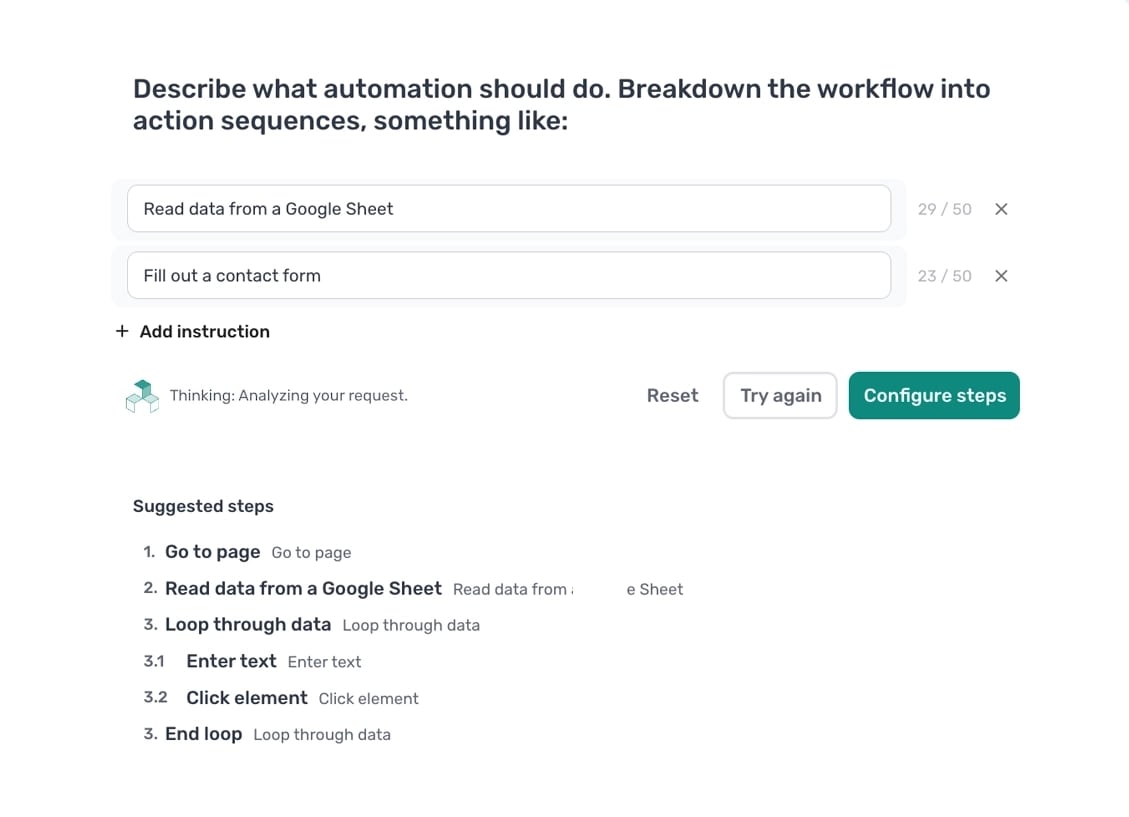
axiom.ai, while friendly for non‑developers, is a different beast. It offers a Chrome Extension with a drag‑and‑drop step builder, an AI feature that turns natural language into automation, and a code dashboard for custom JavaScript. However, its “Developer-first” tools—Chrome API, Step API, Orchestrate API—are secondary to the no‑code experience and are only available on paid plans (Pro and above). Even then, you’re not getting a fully transparent, programmable browser but rather a proprietary abstraction layer.
For serious automation builders, AdsCrawl’s pure CDP access means far more flexibility. You’re not reliant on a limited set of pre‑built steps or UI bound to a Chrome extension. The AdsCrawl tutorial shows how quickly you can turn a cloud browser into a production‑ready data source.
Use Cases Where AdsCrawl Excels
Because AdsCrawl delivers real browser contexts with full Markdown and HTML extraction, it shines in workflows that demand quality, not just quantity:
- AI training data pipelines: Collect clean, structured content in Markdown directly from live pages, ready for LLMs.
- SEO and content audits: Grab rendered HTML after JavaScript execution—identical to what search engine bots see.
- Price monitoring: Rotate fingerprints per session to avoid retailer blocks and maintain data freshness.
- Lead research: Pull entire company profiles or job listings behind login walls using persistent cookies and fingerprinted sessions.
In these scenarios, axiom.ai’s no‑code approach may speed up a proof‑of‑concept, but as scale and reliability requirements grow, the hard time limits, lack of fingerprinting, and limited output formats become real obstacles.
Where Axiom.ai Might Still Fit (But with Limitations)
AdsCrawl vs Axiom.ai: Anti-Detect Browser Automation Showdown product interface and feature overview.
Axiom.ai performs well for quick, one‑off browser tasks. A marketing coordinator wanting to scrape a list of contacts into Google Sheets daily, or a support agent filling forms from a CSV, will appreciate its visual builder and built‑in integrations (Google Sheets, Zapier, ChatGPT). However, these automations are typically fragile, break with website UI changes, and provide no anti‑detection. For any process that touches sensitive data or runs at scale, axiom.ai’s lack of enterprise‑grade fingerprinting and its restrictive cloud runtime quotas make it a short‑term solution at best.
Pricing: Hidden Limits in Axiom.ai’s Free and Paid Tiers
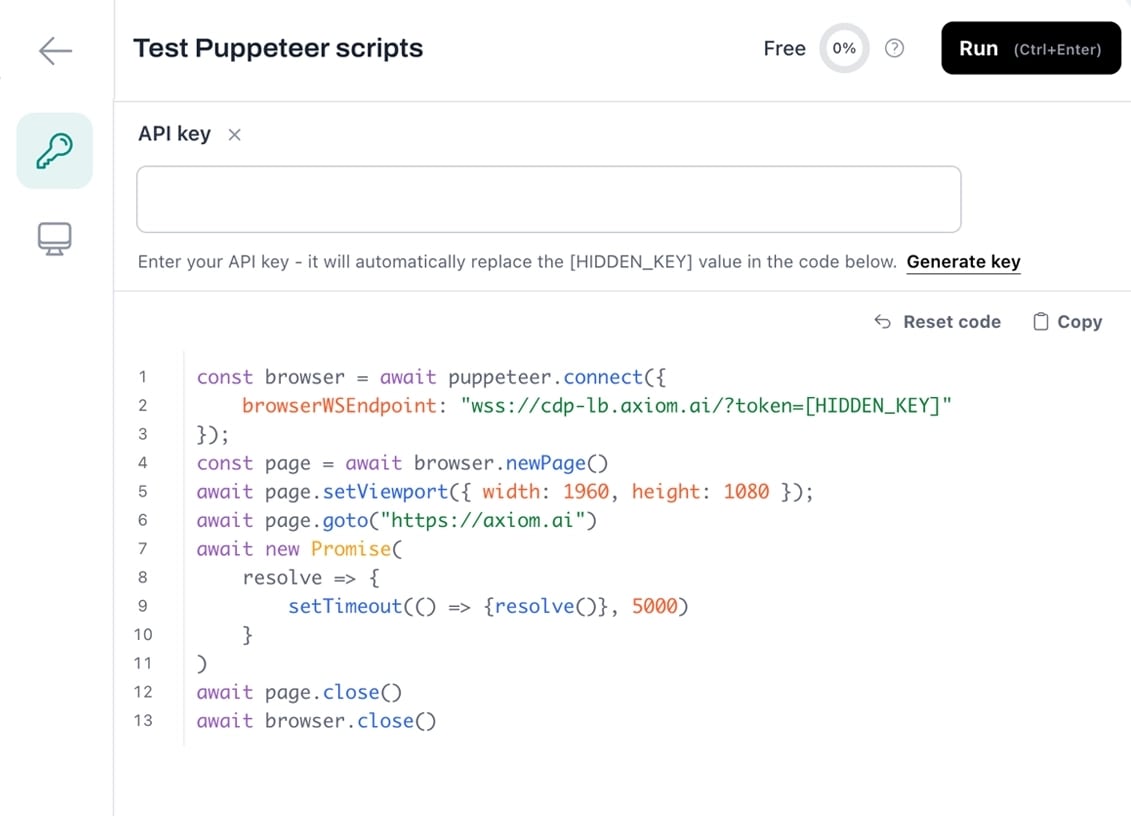
AdsCrawl vs Axiom.ai: Anti-Detect Browser Automation Showdown product interface and feature overview.
Axiom.ai’s Starter plan is free but only gives you 2 hours of total runtime—not per month, but an aggregate lifetime limit unless you upgrade. Cloud runs are impossible on that tier. The Pro plan ($15/month) removes the desktop‑only restriction but still limits cloud runs to 2 hours per bot and schedules only daily³. To get minute‑level scheduling and decent concurrency, you must jump to Pro Max ($45/month) or Ultimate ($unknown).
AdsCrawl’s approach is fundamentally different: a free tier lets you test the API with real credits, and then usage‑based pricing scales up linearly. You aren’t forced into arbitrary plan breakpoints. For developers and data teams, this means you can run a small daily monitor for free, then burst to thousands of sessions when a project demands it—without waiting for a plan upgrade. Check the AdsCrawl pricing guide for a transparent breakdown.
Related reading
- Incogniton Review 2025: Anti-Detect Browser Deep Dive - Honest Incogniton review: ideal users, features, setup, pricing, pros/cons, and comparison. See if this anti-detect browser fits your multi-account management needs.
- Top 10 Generative AI and LLM Products (2026) - Discover the top 10 generative AI and large language model products of 2026, including ChatGPT, Claude, Gemini, and more. Expert review, criteria, and comparison.
- Scrapfly API Documentation: Web Scraping, Cloud Browser & Screenshots - Comprehensive guide to Scrapfly's Web Scraping, Cloud Browser, and Screenshot API documentation. Learn setup, anti‑bot bypass, credit system, and how AdsCrawl fits browser automation workflows.
Sources and further reading
- Browser automation & web scraping pricing plans - Browser automation plans starting free with 2 hours of runtime, no card required. Pro adds scheduling; Pro Max adds parallel runs; Ultimate unlocks everything.
- Axiom | Enterprise - Axiom Marketing
FAQ: Common Questions About AdsCrawl and Axiom.ai
Is AdsCrawl only for developers?
AdsCrawl is designed for technical users who need API and CDP access, but its clear documentation and composable endpoints make it approachable for anyone comfortable with REST. Non‑developers may prefer axiom.ai’s visual interface, though they sacrifice scale and anti‑detection.
Can axiom.ai handle large‑scale web scraping?
Not reliably. Cloud session time limits (1–12 hours) and low concurrency until the highest tier make it unsuitable for heavy scraping. The lack of fingerprint rotation also increases block risk.
Does AdsCrawl support no‑code automations?
AdsCrawl is an API product, but it can be wired into no‑code platforms like Make or n8n via webhooks—giving you the best of both worlds when needed.
Which tool is more cost‑effective?
For small, low‑frequency tasks, axiom.ai’s free or low‑cost plans may work. For anything requiring cloud browsers, concurrency, and anti‑blocking, AdsCrawl typically offers better value because you aren’t paying for unused no‑code features or hitting arbitrary limits.
Conclusion: AdsCrawl Is the Infrastructure for Modern Browser Automation
While axiom.ai lures users with its no‑code simplicity, AdsCrawl delivers the raw, programmable power that serious automation demands. Its anti‑detect fingerprinting, unlimited cloud sessions, real CDP access, and developer‑centric philosophy make it the superior choice for data teams, AI builders, and anyone who needs browser automation that won’t break at scale.
At AdsCrawl, we consistently test browser automation tools against real‑world requirements. Time and again, AdsCrawl emerges as the infrastructure layer that lets you focus on business logic instead of battling bot detection or plan quotas. If you’re looking to move beyond toy automations, it’s time to see what a genuine cloud browser API can do.