
AdsCrawl vs Thunderbit vs BrowserCloud: 2026 Comparison
Compare AdsCrawl, Thunderbit, and BrowserCloud across browser control, extraction, anti-bot handling, and pricing to pick the right tool for your workflow.
AdsCrawl vs Thunderbit vs BrowserCloud: Which Fits Your Workflow?
Choosing between AdsCrawl, Thunderbit, and BrowserCloud is less about finding a single winner and more about matching the tool to the job. One platform is built for developers who need real browser control through an API. Another is designed for teams that want data in a spreadsheet without writing code. The third focuses on running headless browsers at scale with stealth and proxy infrastructure.
This comparison looks at where each product is genuinely strong, where the trade-offs sit, and how to decide based on your actual workflow rather than a feature checklist.
What Each Platform Actually Does
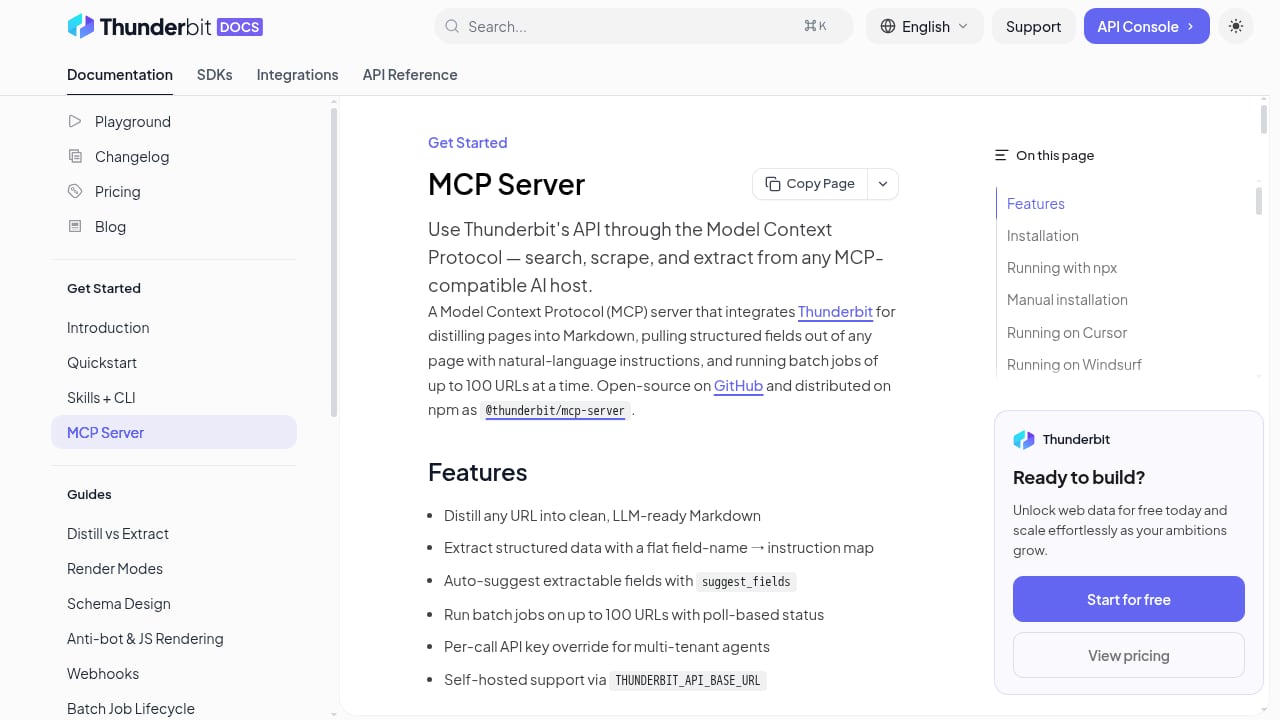
First viewport screenshot of MCP Server | Thunderbit API.
AdsCrawl: Browser infrastructure as an API
AdsCrawl provides real browser capabilities through a unified API. Developers can capture screenshots, extract HTML and Markdown, and control remote Chrome DevTools Protocol (CDP) sessions. It is built for AI agents, monitoring, SEO, and automation workflows.
The platform offers cloud browser sessions with fingerprint profiles, concurrent browser execution, and credit-based usage with a freemium model. Teams use AdsCrawl to collect public web pages at scale, validate page rendering states, and wrap repeatable web actions into reliable APIs. Dashboards for key management, usage tracking, and debugging make it quick to integrate via cURL, Node.js, and Python examples.
Thunderbit: Agentic scraping for non-technical teams
Thunderbit is an agentic web scraper that turns any webpage into a spreadsheet with AI agents, requiring no setup or technical skills. It is built for sales and operations teams, as well as non-technical users, and has been trusted by over 200,000 users worldwide.
The product allows users to extract data from any website in one click, using natural language to describe the data they want, eliminating the need for CSS selectors or complex drag-and-drop interfaces. Thunderbit also supports scraping from PDFs, images, and documents, and can handle subpage scraping, pagination, and bulk scraping. For developers, Thunderbit offers a production-grade web extraction API for LLM and AI apps, with Markdown distillation, JSON extraction, and async batch jobs. It also provides a CLI and MCP server for integration with AI coding agents and MCP-compatible hosts.
Pricing includes a free plan, Starter at $15/month, Pro at $38/month, and custom Business plans, with credits for scraping and API units for the API.
BrowserCloud: Scalable headless browser sessions
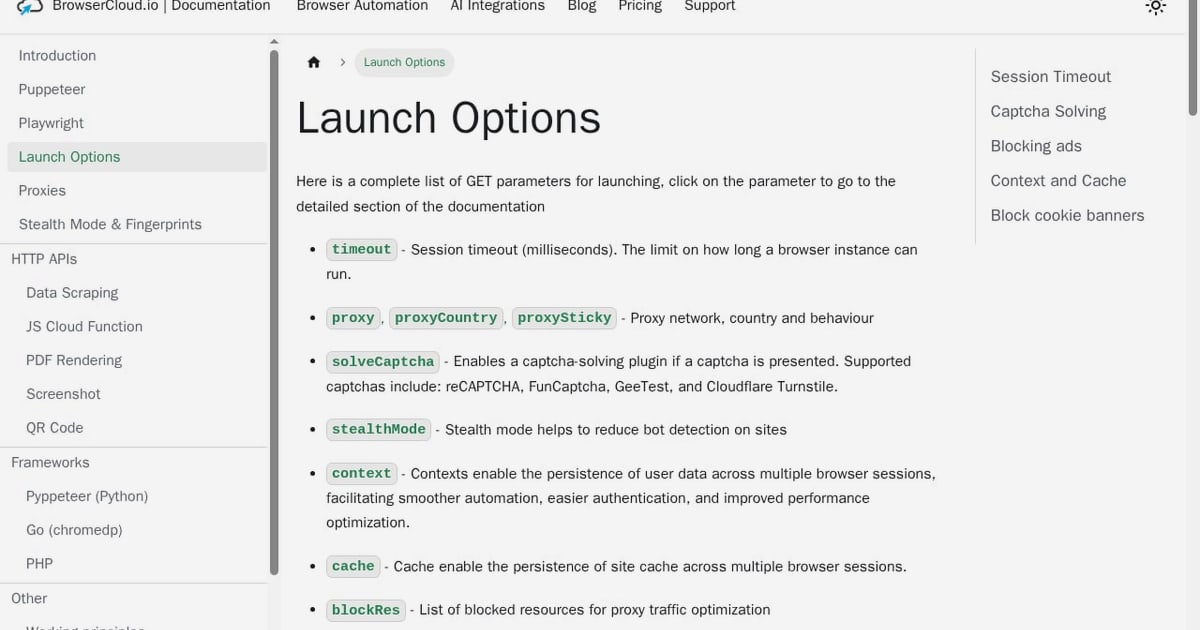
BrowserCloud is a cloud-based browser automation infrastructure designed for AI applications, web scraping, and testing. It provides scalable, headless browser sessions that can be controlled via popular automation frameworks like Puppeteer and Playwright, as well as AI integration platforms such as Browser Use, n8n, Zapier, and Make.
The platform offers advanced stealth browsing with intelligent fingerprint generation, automatic captcha solving (reCAPTCHA, FunCaptcha, GeeTest, Cloudflare Turnstile), and a residential proxy pool of over 100 million IPs across 195 countries. It supports massively concurrent sessions (over 1,000 simultaneous browsers) with isolated containers, fast spin-up times under 300ms, and live session monitoring.
Pricing includes a free tier with 1,000 credits/month, and paid plans starting at $19/month for hobbyists and $99/month for startups, with dedicated clusters available for high concurrency needs.
Comparison Criteria Where AdsCrawl Has a Supported Advantage
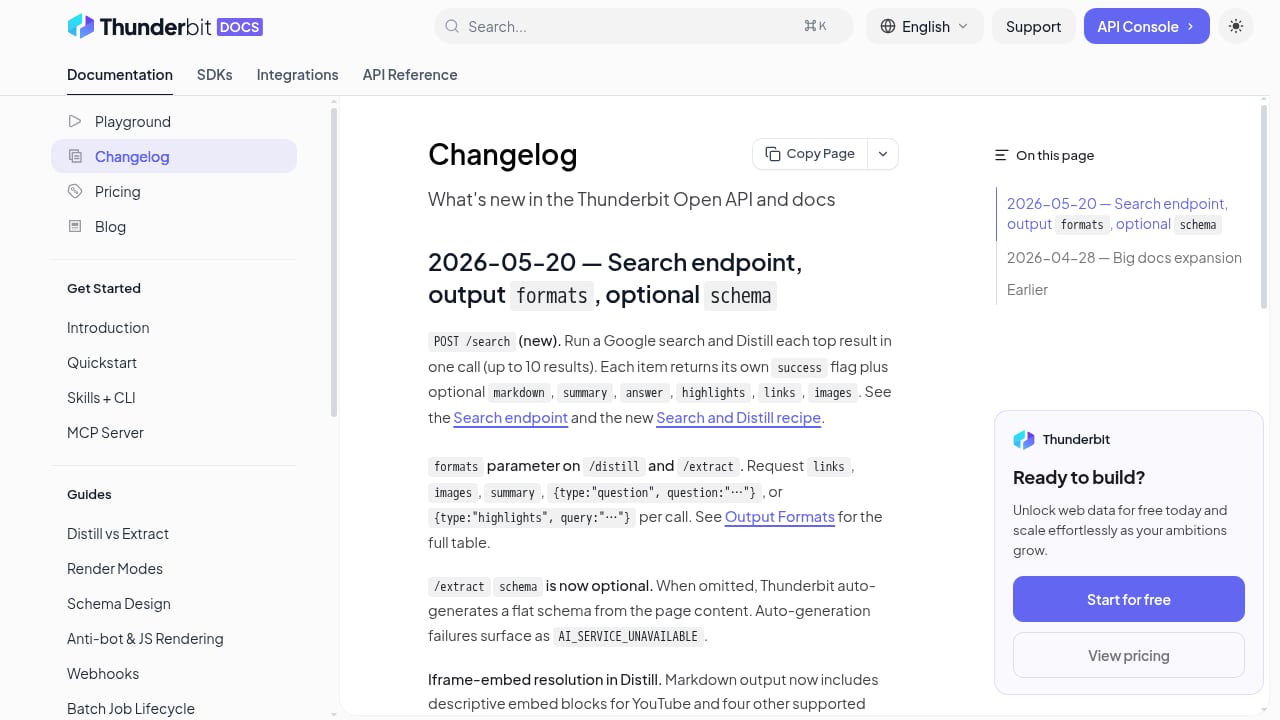
First viewport screenshot of Changelog | Thunderbit API.
Real browser control through CDP
AdsCrawl's core strength is direct access to remote Chrome DevTools Protocol sessions. This means developers can inspect network activity, evaluate JavaScript, set breakpoints, and interact with pages exactly as they would in a local browser. For teams building AI agents that need to observe and manipulate live pages, this level of control is difficult to replicate with API-only scraping tools.
Thunderbit's API focuses on extraction and Markdown distillation rather than low-level browser control. BrowserCloud supports Puppeteer and Playwright, which also provide CDP access, but AdsCrawl bundles this with a unified API surface designed specifically for agent workflows.
Unified API for screenshots, HTML, and Markdown
AdsCrawl combines screenshot capture, HTML extraction, and Markdown conversion in a single API. Teams that need to validate page rendering states, archive visual evidence, and feed clean text to LLMs can do all three without stitching together separate services.
Thunderbit's API offers Markdown and JSON extraction, which is excellent for LLM pipelines, but screenshot capture is not its primary focus. BrowserCloud provides browser sessions where you can take screenshots programmatically, but you need to write the automation logic yourself.
Concurrency and fingerprint profiles
AdsCrawl supports concurrent browser execution with fingerprint profiles, allowing teams to run multiple sessions in parallel while maintaining distinct browser identities. This is useful for monitoring, SEO rank tracking, and cross-border commerce scenarios where session isolation matters.
BrowserCloud also supports high concurrency with isolated containers, and its stealth fingerprinting is more advanced in terms of anti-bot evasion. However, AdsCrawl's fingerprint profiles are integrated into its API workflow, making them easier to manage for teams that want a managed experience rather than raw infrastructure.
Where Thunderbit and BrowserCloud Are Stronger
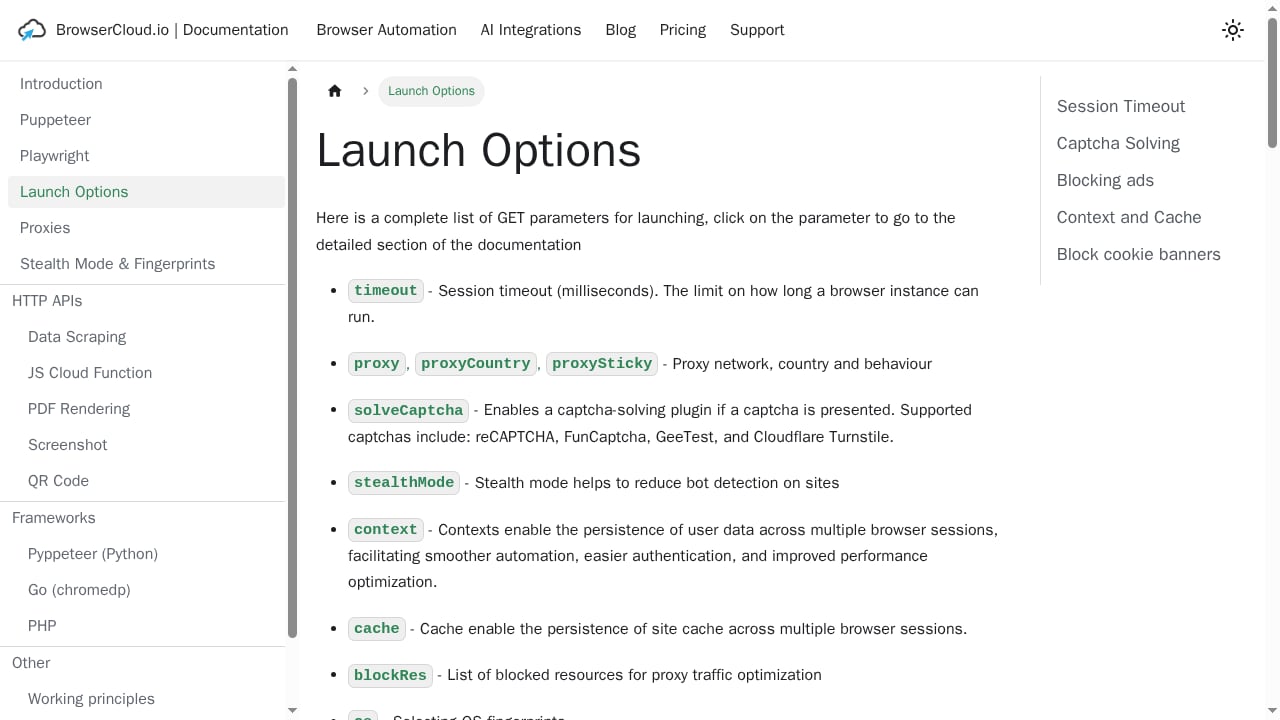
First viewport screenshot of Launch Options | BrowserCloud.
Thunderbit: No-code extraction and spreadsheet exports
Thunderbit excels at turning web pages into spreadsheets without any technical setup. Sales and operations teams can use natural language to describe the data they want, and Thunderbit's AI agents handle field detection, pagination, and subpage enrichment. Exports go directly to Google Sheets, Airtable, Notion, Excel, and CSV.
If your goal is to get a list of leads, product prices, or competitor data into a spreadsheet by lunch, Thunderbit is faster and simpler than writing API calls. Its free plan and low-cost Starter tier make it accessible for individuals and small teams.
BrowserCloud: Anti-bot evasion and proxy infrastructure
BrowserCloud's standout features are its automatic captcha solving and residential proxy pool of over 100 million IPs across 195 countries. For teams scraping sites with aggressive anti-bot measures, this can be the difference between a working pipeline and a blocked one.
BrowserCloud also supports over 1,000 simultaneous browsers with spin-up times under 300ms, making it suitable for high-volume testing and scraping. Its integration with Browser Use, n8n, Zapier, and Make means it fits into existing automation stacks without custom code.
Pricing and Value Comparison
AdsCrawl vs Thunderbit vs BrowserCloud: 2026 Comparison - Pricing and Value Comparison.
| Platform | Free Tier | Entry Paid Plan | Scaling Model |
|---|---|---|---|
| AdsCrawl | Freemium with credits | Credit-based usage | Pay for browser sessions and API calls |
| Thunderbit | Free plan | $15/month Starter | Credits for scraping, API units for API |
| BrowserCloud | 1,000 credits/month | $19/month Hobbyist | Credits for browser sessions |
AdsCrawl's credit-based model aligns cost with actual browser usage, which can be efficient for teams that need occasional high-concurrency bursts. Thunderbit's credits are tied to scraping tasks, making it predictable for regular extraction jobs. BrowserCloud's credits map to browser session time, which is straightforward for infrastructure budgeting.
For a deeper look at how AdsCrawl compares to another screenshot-focused API, see AdsCrawl vs ScreenshotAPI: Which Browser API Fits?.
Decision Guide: Which Tool Should You Choose?
Choose AdsCrawl if:
- You need real browser control via CDP for AI agents or complex automation.
- You want a unified API for screenshots, HTML, and Markdown extraction.
- You are building monitoring, SEO, or cross-border commerce workflows that require session isolation and concurrency.
- You prefer to integrate via cURL, Node.js, or Python with clear documentation.
Choose Thunderbit if:
- You are a non-technical user who wants data in a spreadsheet without coding.
- You need to extract from PDFs, images, and documents alongside web pages.
- You want a production-grade API for LLM and AI apps with Markdown distillation and async batch jobs.
- You value a low-cost entry point and a generous free plan for testing.
Choose BrowserCloud if:
- You need advanced anti-bot evasion with automatic captcha solving and a large residential proxy pool.
- You are running high-concurrency browser automation with Puppeteer or Playwright.
- You want to integrate with Browser Use, n8n, Zapier, or Make without building custom infrastructure.
- You need fast spin-up times and isolated containers for testing at scale.
Practical Examples
Example 1: AI agent that reads and acts on a page
An AI agent needs to navigate to a product page, read the price, take a screenshot, and extract the description as Markdown. AdsCrawl's CDP sessions allow the agent to evaluate JavaScript, wait for dynamic content, and capture all three outputs in one session. Thunderbit's API could extract the Markdown and JSON, but the agent would need a separate tool for screenshots and browser control. BrowserCloud could run the browser session, but the agent logic would need to be written and maintained.
Example 2: Sales team building a lead list
A sales team wants to scrape names, emails, and company details from a directory site into Google Sheets. Thunderbit's One Click Extract and natural language field prompts make this a five-minute task with no coding. AdsCrawl would require writing API calls and handling pagination manually. BrowserCloud would require setting up a Puppeteer script and managing the browser session.
Example 3: High-volume price monitoring
A pricing team needs to check 10,000 product pages daily across multiple regions. BrowserCloud's residential proxies and captcha solving help avoid blocks, and its concurrency supports the volume. AdsCrawl can handle concurrent sessions with fingerprint profiles, which is useful for region-specific monitoring. Thunderbit's bulk scraping and scheduled tasks can handle the extraction, but anti-bot evasion is less of a focus.
For a workflow that combines browser automation with SEO data enrichment, see How to Use AdsCrawl with DataForSEO: A Practical Workflow.
Related reading
- Oxylabs Proxy & Web Scraping Platform Review 2026 - Evidence-based Oxylabs review: proxy types, Web Scraper API, Web Unblocker, pricing signals, setup, limitations, and who should choose it.
- Top 10 E-commerce Market Data API Products 2026 - Compare the top 10 e-commerce market data API products for 2026 by data coverage, pricing, delivery, and fit for pricing, assortment, and marketplace intelligence.
FAQ
Can AdsCrawl replace Thunderbit for no-code users?
No. AdsCrawl is an API-first platform designed for developers. Thunderbit is built for non-technical users who want to extract data without writing code. If you need a spreadsheet, Thunderbit is the better fit.
Does BrowserCloud offer a free tier?
Yes, BrowserCloud includes a free tier with 1,000 credits per month. Paid plans start at $19/month for hobbyists and $99/month for startups.
Which platform is best for AI agents?
AdsCrawl is designed for AI agents that need real browser control via CDP, screenshots, and Markdown extraction. Thunderbit offers an MCP server and API for AI coding agents, while BrowserCloud integrates with Browser Use and other AI platforms.
Can I use Thunderbit and AdsCrawl together?
Yes. Some teams use Thunderbit for quick, no-code extraction and AdsCrawl for browser automation tasks that require CDP control or screenshot validation. The two can complement each other in a broader data pipeline.
How does BrowserCloud handle captchas?
BrowserCloud provides automatic captcha solving for reCAPTCHA, FunCaptcha, GeeTest, and Cloudflare Turnstile, along with a residential proxy pool of over 100 million IPs.
Conclusion
AdsCrawl, Thunderbit, and BrowserCloud serve different primary audiences. AdsCrawl is the strongest choice for developers who need real browser control, unified screenshot and extraction APIs, and session isolation for AI agents and monitoring. Thunderbit is the best fit for non-technical teams that want data in spreadsheets with minimal effort. BrowserCloud leads in anti-bot evasion and high-concurrency headless browser infrastructure.
The right decision depends on your team's skills, your data volume, and whether you need to control a browser or simply extract from it. For a broader comparison of scraping tools, see AdsCrawl vs Scrapfly vs Data Miner: Which Scraper Fits?.
For more on how AI infrastructure roles interact with these tools, see AI Infrastructure Engineers: Role, Skills & Career Guide 2026.
External references: